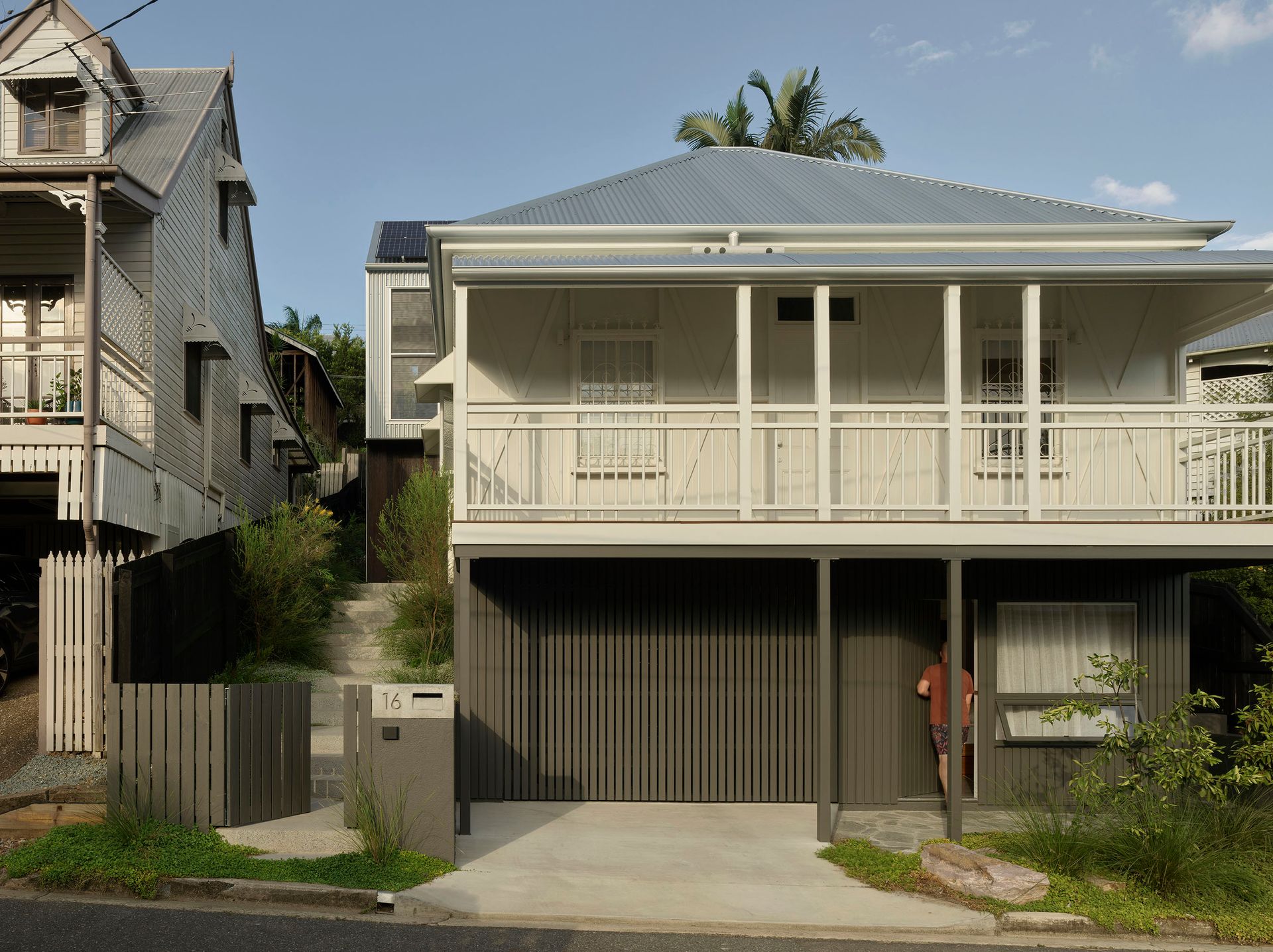
Rob and Emma’s brief centred on creating a flexible, light-filled home that supported family life, remote work, and entertaining—while feeling generous on a steep, compact inner-city block. They requested four bedrooms, a self-contained granny flat, and a kitchen at the heart of the home, tailored to Rob’s love of cooking and hosting. A moveable island, ample storage, flush transitions, and strong indoor–outdoor connection were essential, as was a design that felt special, unconventional, and beautifully integrated with the street.
Our collaborative process centres on translating client aspirations into authentic, site-responsive design. With Rob and Emma, we explored how they wanted to live, not just what they wanted. This informed a vision for a tight but voluminous space that embraced the gardens and courtyard, with our main goals being:
Privacy –The plan was structured into three zones: a restored cottage with kids’ bedrooms, a lofted parents’ retreat above the living space, and a discreetly accessed granny flat beneath. Each zone feels secure and purposeful.
Heart –The kitchen was designed as a functional and social hub, with bespoke storage and a moveable island enabling effortless transition from weekday life to weekend entertaining. The northeast courtyard extends living outdoors, providing shade, privacy and softening the urban edge.
Drama –A central stair void and skylight bring vertical generosity and natural light into the home, making the modest footprint feel spacious and uplifting.
Functionality –Every square metre works hard, with built-in storage woven throughout to support daily routines and social life.
We believe strong processes and practice management lay the foundation for great architecture, prioritising clear communication, financial transparency, and a collaborative approach that puts our clients’ interests at the centre.
Communication
We value genuine connections—our barometer is whether we’d share a drink with our clients. This ease sets the tone for open, honest communication and fosters trust. In our relationship with Rob and Emma, roles and responsibilities were clearly defined during design and construction, keeping everyone engaged and accountable. Monthly updates tied to invoicing and deliverables, program reviews, and rolling meeting minutes kept all parties aligned and informed.
Financial Clarity
From the outset, we had open conversations about budget, working with Rob and Emma to align aspirations with reality. Regular reviews and early builder pricing ensured informed decisions and cost control. Design choices, like a simplified built form and leaving the outdoor area uncovered, allowed investment in high-quality finishes and custom joinery while avoiding unnecessary expenses.
Construction & Quality
Early builder engagement and detailed documentation supported efficient decision-making and high-quality outcomes. A negotiated tender allowed for multiple pricing rounds before contract signing, giving the clients confidence and risk management. The project had just 2.74% in variations, demonstrating the effectiveness of this collaborative approach.
Tighty Whitey was managed through fortnightly site meetings and rolling minutes, ensuring issues were addressed early and decisions recorded. The builder’s robust defect management process ensured the finished home met shared expectations for performance, quality, and longevity.
Rob and Emma’s brief centred on creating a flexible, light-filled home that supported family life, remote work, and entertaining—while feeling generous on a steep, compact inner-city block. They requested four bedrooms, a self-contained granny flat, and a kitchen at the heart of the home, tailored to Rob’s love of cooking and hosting. A moveable island, ample storage, flush transitions, and strong indoor–outdoor connection were essential, as was a design that felt special, unconventional, and beautifully integrated with the street.
Our collaborative process centres on translating client aspirations into authentic, site-responsive design. With Rob and Emma, we explored how they wanted to live, not just what they wanted. This informed a vision for a tight but voluminous space that embraced the gardens and courtyard, with our main goals being:
Privacy –The plan was structured into three zones: a restored cottage with kids’ bedrooms, a lofted parents’ retreat above the living space, and a discreetly accessed granny flat beneath. Each zone feels secure and purposeful.
Heart –The kitchen was designed as a functional and social hub, with bespoke storage and a moveable island enabling effortless transition from weekday life to weekend entertaining. The northeast courtyard extends living outdoors, providing shade, privacy and softening the urban edge.
Drama –A central stair void and skylight bring vertical generosity and natural light into the home, making the modest footprint feel spacious and uplifting.
Functionality –Every square metre works hard, with built-in storage woven throughout to support daily routines and social life.
We believe strong processes and practice management lay the foundation for great architecture, prioritising clear communication, financial transparency, and a collaborative approach that puts our clients’ interests at the centre.
Communication
We value genuine connections—our barometer is whether we’d share a drink with our clients. This ease sets the tone for open, honest communication and fosters trust. In our relationship with Rob and Emma, roles and responsibilities were clearly defined during design and construction, keeping everyone engaged and accountable. Monthly updates tied to invoicing and deliverables, program reviews, and rolling meeting minutes kept all parties aligned and informed.
Financial Clarity
From the outset, we had open conversations about budget, working with Rob and Emma to align aspirations with reality. Regular reviews and early builder pricing ensured informed decisions and cost control. Design choices, like a simplified built form and leaving the outdoor area uncovered, allowed investment in high-quality finishes and custom joinery while avoiding unnecessary expenses.
Construction & Quality
Early builder engagement and detailed documentation supported efficient decision-making and high-quality outcomes. A negotiated tender allowed for multiple pricing rounds before contract signing, giving the clients confidence and risk management. The project had just 2.74% in variations, demonstrating the effectiveness of this collaborative approach.
Tighty Whitey was managed through fortnightly site meetings and rolling minutes, ensuring issues were addressed early and decisions recorded. The builder’s robust defect management process ensured the finished home met shared expectations for performance, quality, and longevity.
Rob and Emma’s brief centred on creating a flexible, light-filled home that supported family life, remote work, and entertaining—while feeling generous on a steep, compact inner-city block. They requested four bedrooms, a self-contained granny flat, and a kitchen at the heart of the home, tailored to Rob’s love of cooking and hosting. A moveable island, ample storage, flush transitions, and strong indoor–outdoor connection were essential, as was a design that felt special, unconventional, and beautifully integrated with the street.
Our collaborative process centres on translating client aspirations into authentic, site-responsive design. With Rob and Emma, we explored how they wanted to live, not just what they wanted. This informed a vision for a tight but voluminous space that embraced the gardens and courtyard, with our main goals being:
Privacy –The plan was structured into three zones: a restored cottage with kids’ bedrooms, a lofted parents’ retreat above the living space, and a discreetly accessed granny flat beneath. Each zone feels secure and purposeful.
Heart –The kitchen was designed as a functional and social hub, with bespoke storage and a moveable island enabling effortless transition from weekday life to weekend entertaining. The northeast courtyard extends living outdoors, providing shade, privacy and softening the urban edge.
Drama –A central stair void and skylight bring vertical generosity and natural light into the home, making the modest footprint feel spacious and uplifting.
Functionality –Every square metre works hard, with built-in storage woven throughout to support daily routines and social life.
We believe strong processes and practice management lay the foundation for great architecture, prioritising clear communication, financial transparency, and a collaborative approach that puts our clients’ interests at the centre.
Communication
We value genuine connections—our barometer is whether we’d share a drink with our clients. This ease sets the tone for open, honest communication and fosters trust. In our relationship with Rob and Emma, roles and responsibilities were clearly defined during design and construction, keeping everyone engaged and accountable. Monthly updates tied to invoicing and deliverables, program reviews, and rolling meeting minutes kept all parties aligned and informed.
Financial Clarity
From the outset, we had open conversations about budget, working with Rob and Emma to align aspirations with reality. Regular reviews and early builder pricing ensured informed decisions and cost control. Design choices, like a simplified built form and leaving the outdoor area uncovered, allowed investment in high-quality finishes and custom joinery while avoiding unnecessary expenses.
Construction & Quality
Early builder engagement and detailed documentation supported efficient decision-making and high-quality outcomes. A negotiated tender allowed for multiple pricing rounds before contract signing, giving the clients confidence and risk management. The project had just 2.74% in variations, demonstrating the effectiveness of this collaborative approach.
Tighty Whitey was managed through fortnightly site meetings and rolling minutes, ensuring issues were addressed early and decisions recorded. The builder’s robust defect management process ensured the finished home met shared expectations for performance, quality, and longevity.
Rob and Emma’s brief centred on creating a flexible, light-filled home that supported family life, remote work, and entertaining—while feeling generous on a steep, compact inner-city block. They requested four bedrooms, a self-contained granny flat, and a kitchen at the heart of the home, tailored to Rob’s love of cooking and hosting. A moveable island, ample storage, flush transitions, and strong indoor–outdoor connection were essential, as was a design that felt special, unconventional, and beautifully integrated with the street.
Our collaborative process centres on translating client aspirations into authentic, site-responsive design. With Rob and Emma, we explored how they wanted to live, not just what they wanted. This informed a vision for a tight but voluminous space that embraced the gardens and courtyard, with our main goals being:
Privacy –The plan was structured into three zones: a restored cottage with kids’ bedrooms, a lofted parents’ retreat above the living space, and a discreetly accessed granny flat beneath. Each zone feels secure and purposeful.
Heart –The kitchen was designed as a functional and social hub, with bespoke storage and a moveable island enabling effortless transition from weekday life to weekend entertaining. The northeast courtyard extends living outdoors, providing shade, privacy and softening the urban edge.
Drama –A central stair void and skylight bring vertical generosity and natural light into the home, making the modest footprint feel spacious and uplifting.
Functionality –Every square metre works hard, with built-in storage woven throughout to support daily routines and social life.
We believe strong processes and practice management lay the foundation for great architecture, prioritising clear communication, financial transparency, and a collaborative approach that puts our clients’ interests at the centre.
Communication
We value genuine connections—our barometer is whether we’d share a drink with our clients. This ease sets the tone for open, honest communication and fosters trust. In our relationship with Rob and Emma, roles and responsibilities were clearly defined during design and construction, keeping everyone engaged and accountable. Monthly updates tied to invoicing and deliverables, program reviews, and rolling meeting minutes kept all parties aligned and informed.
Financial Clarity
From the outset, we had open conversations about budget, working with Rob and Emma to align aspirations with reality. Regular reviews and early builder pricing ensured informed decisions and cost control. Design choices, like a simplified built form and leaving the outdoor area uncovered, allowed investment in high-quality finishes and custom joinery while avoiding unnecessary expenses.
Construction & Quality
Early builder engagement and detailed documentation supported efficient decision-making and high-quality outcomes. A negotiated tender allowed for multiple pricing rounds before contract signing, giving the clients confidence and risk management. The project had just 2.74% in variations, demonstrating the effectiveness of this collaborative approach.
Tighty Whitey was managed through fortnightly site meetings and rolling minutes, ensuring issues were addressed early and decisions recorded. The builder’s robust defect management process ensured the finished home met shared expectations for performance, quality, and longevity.
Rob and Emma’s brief centred on creating a flexible, light-filled home that supported family life, remote work, and entertaining—while feeling generous on a steep, compact inner-city block. They requested four bedrooms, a self-contained granny flat, and a kitchen at the heart of the home, tailored to Rob’s love of cooking and hosting. A moveable island, ample storage, flush transitions, and strong indoor–outdoor connection were essential, as was a design that felt special, unconventional, and beautifully integrated with the street.
Our collaborative process centres on translating client aspirations into authentic, site-responsive design. With Rob and Emma, we explored how they wanted to live, not just what they wanted. This informed a vision for a tight but voluminous space that embraced the gardens and courtyard, with our main goals being:
Privacy –The plan was structured into three zones: a restored cottage with kids’ bedrooms, a lofted parents’ retreat above the living space, and a discreetly accessed granny flat beneath. Each zone feels secure and purposeful.
Heart –The kitchen was designed as a functional and social hub, with bespoke storage and a moveable island enabling effortless transition from weekday life to weekend entertaining. The northeast courtyard extends living outdoors, providing shade, privacy and softening the urban edge.
Drama –A central stair void and skylight bring vertical generosity and natural light into the home, making the modest footprint feel spacious and uplifting.
Functionality –Every square metre works hard, with built-in storage woven throughout to support daily routines and social life.
We believe strong processes and practice management lay the foundation for great architecture, prioritising clear communication, financial transparency, and a collaborative approach that puts our clients’ interests at the centre.
Communication
We value genuine connections—our barometer is whether we’d share a drink with our clients. This ease sets the tone for open, honest communication and fosters trust. In our relationship with Rob and Emma, roles and responsibilities were clearly defined during design and construction, keeping everyone engaged and accountable. Monthly updates tied to invoicing and deliverables, program reviews, and rolling meeting minutes kept all parties aligned and informed.
Financial Clarity
From the outset, we had open conversations about budget, working with Rob and Emma to align aspirations with reality. Regular reviews and early builder pricing ensured informed decisions and cost control. Design choices, like a simplified built form and leaving the outdoor area uncovered, allowed investment in high-quality finishes and custom joinery while avoiding unnecessary expenses.
Construction & Quality
Early builder engagement and detailed documentation supported efficient decision-making and high-quality outcomes. A negotiated tender allowed for multiple pricing rounds before contract signing, giving the clients confidence and risk management. The project had just 2.74% in variations, demonstrating the effectiveness of this collaborative approach.
Tighty Whitey was managed through fortnightly site meetings and rolling minutes, ensuring issues were addressed early and decisions recorded. The builder’s robust defect management process ensured the finished home met shared expectations for performance, quality, and longevity.
Rob and Emma’s brief centred on creating a flexible, light-filled home that supported family life, remote work, and entertaining—while feeling generous on a steep, compact inner-city block. They requested four bedrooms, a self-contained granny flat, and a kitchen at the heart of the home, tailored to Rob’s love of cooking and hosting. A moveable island, ample storage, flush transitions, and strong indoor–outdoor connection were essential, as was a design that felt special, unconventional, and beautifully integrated with the street.
Our collaborative process centres on translating client aspirations into authentic, site-responsive design. With Rob and Emma, we explored how they wanted to live, not just what they wanted. This informed a vision for a tight but voluminous space that embraced the gardens and courtyard, with our main goals being:
Privacy –The plan was structured into three zones: a restored cottage with kids’ bedrooms, a lofted parents’ retreat above the living space, and a discreetly accessed granny flat beneath. Each zone feels secure and purposeful.
Heart –The kitchen was designed as a functional and social hub, with bespoke storage and a moveable island enabling effortless transition from weekday life to weekend entertaining. The northeast courtyard extends living outdoors, providing shade, privacy and softening the urban edge.
Drama –A central stair void and skylight bring vertical generosity and natural light into the home, making the modest footprint feel spacious and uplifting.
Functionality –Every square metre works hard, with built-in storage woven throughout to support daily routines and social life.
We believe strong processes and practice management lay the foundation for great architecture, prioritising clear communication, financial transparency, and a collaborative approach that puts our clients’ interests at the centre.
Communication
We value genuine connections—our barometer is whether we’d share a drink with our clients. This ease sets the tone for open, honest communication and fosters trust. In our relationship with Rob and Emma, roles and responsibilities were clearly defined during design and construction, keeping everyone engaged and accountable. Monthly updates tied to invoicing and deliverables, program reviews, and rolling meeting minutes kept all parties aligned and informed.
Financial Clarity
From the outset, we had open conversations about budget, working with Rob and Emma to align aspirations with reality. Regular reviews and early builder pricing ensured informed decisions and cost control. Design choices, like a simplified built form and leaving the outdoor area uncovered, allowed investment in high-quality finishes and custom joinery while avoiding unnecessary expenses.
Construction & Quality
Early builder engagement and detailed documentation supported efficient decision-making and high-quality outcomes. A negotiated tender allowed for multiple pricing rounds before contract signing, giving the clients confidence and risk management. The project had just 2.74% in variations, demonstrating the effectiveness of this collaborative approach.
Tighty Whitey was managed through fortnightly site meetings and rolling minutes, ensuring issues were addressed early and decisions recorded. The builder’s robust defect management process ensured the finished home met shared expectations for performance, quality, and longevity.
Rob and Emma’s brief centred on creating a flexible, light-filled home that supported family life, remote work, and entertaining—while feeling generous on a steep, compact inner-city block. They requested four bedrooms, a self-contained granny flat, and a kitchen at the heart of the home, tailored to Rob’s love of cooking and hosting. A moveable island, ample storage, flush transitions, and strong indoor–outdoor connection were essential, as was a design that felt special, unconventional, and beautifully integrated with the street.
Our collaborative process centres on translating client aspirations into authentic, site-responsive design. With Rob and Emma, we explored how they wanted to live, not just what they wanted. This informed a vision for a tight but voluminous space that embraced the gardens and courtyard, with our main goals being:
Privacy –The plan was structured into three zones: a restored cottage with kids’ bedrooms, a lofted parents’ retreat above the living space, and a discreetly accessed granny flat beneath. Each zone feels secure and purposeful.
Heart –The kitchen was designed as a functional and social hub, with bespoke storage and a moveable island enabling effortless transition from weekday life to weekend entertaining. The northeast courtyard extends living outdoors, providing shade, privacy and softening the urban edge.
Drama –A central stair void and skylight bring vertical generosity and natural light into the home, making the modest footprint feel spacious and uplifting.
Functionality –Every square metre works hard, with built-in storage woven throughout to support daily routines and social life.
We believe strong processes and practice management lay the foundation for great architecture, prioritising clear communication, financial transparency, and a collaborative approach that puts our clients’ interests at the centre.
Communication
We value genuine connections—our barometer is whether we’d share a drink with our clients. This ease sets the tone for open, honest communication and fosters trust. In our relationship with Rob and Emma, roles and responsibilities were clearly defined during design and construction, keeping everyone engaged and accountable. Monthly updates tied to invoicing and deliverables, program reviews, and rolling meeting minutes kept all parties aligned and informed.
Financial Clarity
From the outset, we had open conversations about budget, working with Rob and Emma to align aspirations with reality. Regular reviews and early builder pricing ensured informed decisions and cost control. Design choices, like a simplified built form and leaving the outdoor area uncovered, allowed investment in high-quality finishes and custom joinery while avoiding unnecessary expenses.
Construction & Quality
Early builder engagement and detailed documentation supported efficient decision-making and high-quality outcomes. A negotiated tender allowed for multiple pricing rounds before contract signing, giving the clients confidence and risk management. The project had just 2.74% in variations, demonstrating the effectiveness of this collaborative approach.
Tighty Whitey was managed through fortnightly site meetings and rolling minutes, ensuring issues were addressed early and decisions recorded. The builder’s robust defect management process ensured the finished home met shared expectations for performance, quality, and longevity.
Rob and Emma’s brief centred on creating a flexible, light-filled home that supported family life, remote work, and entertaining—while feeling generous on a steep, compact inner-city block. They requested four bedrooms, a self-contained granny flat, and a kitchen at the heart of the home, tailored to Rob’s love of cooking and hosting. A moveable island, ample storage, flush transitions, and strong indoor–outdoor connection were essential, as was a design that felt special, unconventional, and beautifully integrated with the street.
Our collaborative process centres on translating client aspirations into authentic, site-responsive design. With Rob and Emma, we explored how they wanted to live, not just what they wanted. This informed a vision for a tight but voluminous space that embraced the gardens and courtyard, with our main goals being:
Privacy –The plan was structured into three zones: a restored cottage with kids’ bedrooms, a lofted parents’ retreat above the living space, and a discreetly accessed granny flat beneath. Each zone feels secure and purposeful.
Heart –The kitchen was designed as a functional and social hub, with bespoke storage and a moveable island enabling effortless transition from weekday life to weekend entertaining. The northeast courtyard extends living outdoors, providing shade, privacy and softening the urban edge.
Drama –A central stair void and skylight bring vertical generosity and natural light into the home, making the modest footprint feel spacious and uplifting.
Functionality –Every square metre works hard, with built-in storage woven throughout to support daily routines and social life.
We believe strong processes and practice management lay the foundation for great architecture, prioritising clear communication, financial transparency, and a collaborative approach that puts our clients’ interests at the centre.
Communication
We value genuine connections—our barometer is whether we’d share a drink with our clients. This ease sets the tone for open, honest communication and fosters trust. In our relationship with Rob and Emma, roles and responsibilities were clearly defined during design and construction, keeping everyone engaged and accountable. Monthly updates tied to invoicing and deliverables, program reviews, and rolling meeting minutes kept all parties aligned and informed.
Financial Clarity
From the outset, we had open conversations about budget, working with Rob and Emma to align aspirations with reality. Regular reviews and early builder pricing ensured informed decisions and cost control. Design choices, like a simplified built form and leaving the outdoor area uncovered, allowed investment in high-quality finishes and custom joinery while avoiding unnecessary expenses.
Construction & Quality
Early builder engagement and detailed documentation supported efficient decision-making and high-quality outcomes. A negotiated tender allowed for multiple pricing rounds before contract signing, giving the clients confidence and risk management. The project had just 2.74% in variations, demonstrating the effectiveness of this collaborative approach.
Tighty Whitey was managed through fortnightly site meetings and rolling minutes, ensuring issues were addressed early and decisions recorded. The builder’s robust defect management process ensured the finished home met shared expectations for performance, quality, and longevity.
Rob and Emma’s brief centred on creating a flexible, light-filled home that supported family life, remote work, and entertaining—while feeling generous on a steep, compact inner-city block. They requested four bedrooms, a self-contained granny flat, and a kitchen at the heart of the home, tailored to Rob’s love of cooking and hosting. A moveable island, ample storage, flush transitions, and strong indoor–outdoor connection were essential, as was a design that felt special, unconventional, and beautifully integrated with the street.
Our collaborative process centres on translating client aspirations into authentic, site-responsive design. With Rob and Emma, we explored how they wanted to live, not just what they wanted. This informed a vision for a tight but voluminous space that embraced the gardens and courtyard, with our main goals being:
Privacy –The plan was structured into three zones: a restored cottage with kids’ bedrooms, a lofted parents’ retreat above the living space, and a discreetly accessed granny flat beneath. Each zone feels secure and purposeful.
Heart –The kitchen was designed as a functional and social hub, with bespoke storage and a moveable island enabling effortless transition from weekday life to weekend entertaining. The northeast courtyard extends living outdoors, providing shade, privacy and softening the urban edge.
Drama –A central stair void and skylight bring vertical generosity and natural light into the home, making the modest footprint feel spacious and uplifting.
Functionality –Every square metre works hard, with built-in storage woven throughout to support daily routines and social life.
We believe strong processes and practice management lay the foundation for great architecture, prioritising clear communication, financial transparency, and a collaborative approach that puts our clients’ interests at the centre.
Communication
We value genuine connections—our barometer is whether we’d share a drink with our clients. This ease sets the tone for open, honest communication and fosters trust. In our relationship with Rob and Emma, roles and responsibilities were clearly defined during design and construction, keeping everyone engaged and accountable. Monthly updates tied to invoicing and deliverables, program reviews, and rolling meeting minutes kept all parties aligned and informed.
Financial Clarity
From the outset, we had open conversations about budget, working with Rob and Emma to align aspirations with reality. Regular reviews and early builder pricing ensured informed decisions and cost control. Design choices, like a simplified built form and leaving the outdoor area uncovered, allowed investment in high-quality finishes and custom joinery while avoiding unnecessary expenses.
Construction & Quality
Early builder engagement and detailed documentation supported efficient decision-making and high-quality outcomes. A negotiated tender allowed for multiple pricing rounds before contract signing, giving the clients confidence and risk management. The project had just 2.74% in variations, demonstrating the effectiveness of this collaborative approach.
Tighty Whitey was managed through fortnightly site meetings and rolling minutes, ensuring issues were addressed early and decisions recorded. The builder’s robust defect management process ensured the finished home met shared expectations for performance, quality, and longevity.
Rob and Emma’s brief centred on creating a flexible, light-filled home that supported family life, remote work, and entertaining—while feeling generous on a steep, compact inner-city block. They requested four bedrooms, a self-contained granny flat, and a kitchen at the heart of the home, tailored to Rob’s love of cooking and hosting. A moveable island, ample storage, flush transitions, and strong indoor–outdoor connection were essential, as was a design that felt special, unconventional, and beautifully integrated with the street.
Our collaborative process centres on translating client aspirations into authentic, site-responsive design. With Rob and Emma, we explored how they wanted to live, not just what they wanted. This informed a vision for a tight but voluminous space that embraced the gardens and courtyard, with our main goals being:
Privacy –The plan was structured into three zones: a restored cottage with kids’ bedrooms, a lofted parents’ retreat above the living space, and a discreetly accessed granny flat beneath. Each zone feels secure and purposeful.
Heart –The kitchen was designed as a functional and social hub, with bespoke storage and a moveable island enabling effortless transition from weekday life to weekend entertaining. The northeast courtyard extends living outdoors, providing shade, privacy and softening the urban edge.
Drama –A central stair void and skylight bring vertical generosity and natural light into the home, making the modest footprint feel spacious and uplifting.
Functionality –Every square metre works hard, with built-in storage woven throughout to support daily routines and social life.
We believe strong processes and practice management lay the foundation for great architecture, prioritising clear communication, financial transparency, and a collaborative approach that puts our clients’ interests at the centre.
Communication
We value genuine connections—our barometer is whether we’d share a drink with our clients. This ease sets the tone for open, honest communication and fosters trust. In our relationship with Rob and Emma, roles and responsibilities were clearly defined during design and construction, keeping everyone engaged and accountable. Monthly updates tied to invoicing and deliverables, program reviews, and rolling meeting minutes kept all parties aligned and informed.
Financial Clarity
From the outset, we had open conversations about budget, working with Rob and Emma to align aspirations with reality. Regular reviews and early builder pricing ensured informed decisions and cost control. Design choices, like a simplified built form and leaving the outdoor area uncovered, allowed investment in high-quality finishes and custom joinery while avoiding unnecessary expenses.
Construction & Quality
Early builder engagement and detailed documentation supported efficient decision-making and high-quality outcomes. A negotiated tender allowed for multiple pricing rounds before contract signing, giving the clients confidence and risk management. The project had just 2.74% in variations, demonstrating the effectiveness of this collaborative approach.
Tighty Whitey was managed through fortnightly site meetings and rolling minutes, ensuring issues were addressed early and decisions recorded. The builder’s robust defect management process ensured the finished home met shared expectations for performance, quality, and longevity.
Rob and Emma’s brief centred on creating a flexible, light-filled home that supported family life, remote work, and entertaining—while feeling generous on a steep, compact inner-city block. They requested four bedrooms, a self-contained granny flat, and a kitchen at the heart of the home, tailored to Rob’s love of cooking and hosting. A moveable island, ample storage, flush transitions, and strong indoor–outdoor connection were essential, as was a design that felt special, unconventional, and beautifully integrated with the street.
Our collaborative process centres on translating client aspirations into authentic, site-responsive design. With Rob and Emma, we explored how they wanted to live, not just what they wanted. This informed a vision for a tight but voluminous space that embraced the gardens and courtyard, with our main goals being:
Privacy –The plan was structured into three zones: a restored cottage with kids’ bedrooms, a lofted parents’ retreat above the living space, and a discreetly accessed granny flat beneath. Each zone feels secure and purposeful.
Heart –The kitchen was designed as a functional and social hub, with bespoke storage and a moveable island enabling effortless transition from weekday life to weekend entertaining. The northeast courtyard extends living outdoors, providing shade, privacy and softening the urban edge.
Drama –A central stair void and skylight bring vertical generosity and natural light into the home, making the modest footprint feel spacious and uplifting.
Functionality –Every square metre works hard, with built-in storage woven throughout to support daily routines and social life.
We believe strong processes and practice management lay the foundation for great architecture, prioritising clear communication, financial transparency, and a collaborative approach that puts our clients’ interests at the centre.
Communication
We value genuine connections—our barometer is whether we’d share a drink with our clients. This ease sets the tone for open, honest communication and fosters trust. In our relationship with Rob and Emma, roles and responsibilities were clearly defined during design and construction, keeping everyone engaged and accountable. Monthly updates tied to invoicing and deliverables, program reviews, and rolling meeting minutes kept all parties aligned and informed.
Financial Clarity
From the outset, we had open conversations about budget, working with Rob and Emma to align aspirations with reality. Regular reviews and early builder pricing ensured informed decisions and cost control. Design choices, like a simplified built form and leaving the outdoor area uncovered, allowed investment in high-quality finishes and custom joinery while avoiding unnecessary expenses.
Construction & Quality
Early builder engagement and detailed documentation supported efficient decision-making and high-quality outcomes. A negotiated tender allowed for multiple pricing rounds before contract signing, giving the clients confidence and risk management. The project had just 2.74% in variations, demonstrating the effectiveness of this collaborative approach.
Tighty Whitey was managed through fortnightly site meetings and rolling minutes, ensuring issues were addressed early and decisions recorded. The builder’s robust defect management process ensured the finished home met shared expectations for performance, quality, and longevity.
Rob and Emma’s brief centred on creating a flexible, light-filled home that supported family life, remote work, and entertaining—while feeling generous on a steep, compact inner-city block. They requested four bedrooms, a self-contained granny flat, and a kitchen at the heart of the home, tailored to Rob’s love of cooking and hosting. A moveable island, ample storage, flush transitions, and strong indoor–outdoor connection were essential, as was a design that felt special, unconventional, and beautifully integrated with the street.
Our collaborative process centres on translating client aspirations into authentic, site-responsive design. With Rob and Emma, we explored how they wanted to live, not just what they wanted. This informed a vision for a tight but voluminous space that embraced the gardens and courtyard, with our main goals being:
Privacy –The plan was structured into three zones: a restored cottage with kids’ bedrooms, a lofted parents’ retreat above the living space, and a discreetly accessed granny flat beneath. Each zone feels secure and purposeful.
Heart –The kitchen was designed as a functional and social hub, with bespoke storage and a moveable island enabling effortless transition from weekday life to weekend entertaining. The northeast courtyard extends living outdoors, providing shade, privacy and softening the urban edge.
Drama –A central stair void and skylight bring vertical generosity and natural light into the home, making the modest footprint feel spacious and uplifting.
Functionality –Every square metre works hard, with built-in storage woven throughout to support daily routines and social life.
We believe strong processes and practice management lay the foundation for great architecture, prioritising clear communication, financial transparency, and a collaborative approach that puts our clients’ interests at the centre.
Communication
We value genuine connections—our barometer is whether we’d share a drink with our clients. This ease sets the tone for open, honest communication and fosters trust. In our relationship with Rob and Emma, roles and responsibilities were clearly defined during design and construction, keeping everyone engaged and accountable. Monthly updates tied to invoicing and deliverables, program reviews, and rolling meeting minutes kept all parties aligned and informed.
Financial Clarity
From the outset, we had open conversations about budget, working with Rob and Emma to align aspirations with reality. Regular reviews and early builder pricing ensured informed decisions and cost control. Design choices, like a simplified built form and leaving the outdoor area uncovered, allowed investment in high-quality finishes and custom joinery while avoiding unnecessary expenses.
Construction & Quality
Early builder engagement and detailed documentation supported efficient decision-making and high-quality outcomes. A negotiated tender allowed for multiple pricing rounds before contract signing, giving the clients confidence and risk management. The project had just 2.74% in variations, demonstrating the effectiveness of this collaborative approach.
Tighty Whitey was managed through fortnightly site meetings and rolling minutes, ensuring issues were addressed early and decisions recorded. The builder’s robust defect management process ensured the finished home met shared expectations for performance, quality, and longevity.
Rob and Emma’s brief centred on creating a flexible, light-filled home that supported family life, remote work, and entertaining—while feeling generous on a steep, compact inner-city block. They requested four bedrooms, a self-contained granny flat, and a kitchen at the heart of the home, tailored to Rob’s love of cooking and hosting. A moveable island, ample storage, flush transitions, and strong indoor–outdoor connection were essential, as was a design that felt special, unconventional, and beautifully integrated with the street.
Our collaborative process centres on translating client aspirations into authentic, site-responsive design. With Rob and Emma, we explored how they wanted to live, not just what they wanted. This informed a vision for a tight but voluminous space that embraced the gardens and courtyard, with our main goals being:
Privacy –The plan was structured into three zones: a restored cottage with kids’ bedrooms, a lofted parents’ retreat above the living space, and a discreetly accessed granny flat beneath. Each zone feels secure and purposeful.
Heart –The kitchen was designed as a functional and social hub, with bespoke storage and a moveable island enabling effortless transition from weekday life to weekend entertaining. The northeast courtyard extends living outdoors, providing shade, privacy and softening the urban edge.
Drama –A central stair void and skylight bring vertical generosity and natural light into the home, making the modest footprint feel spacious and uplifting.
Functionality –Every square metre works hard, with built-in storage woven throughout to support daily routines and social life.
We believe strong processes and practice management lay the foundation for great architecture, prioritising clear communication, financial transparency, and a collaborative approach that puts our clients’ interests at the centre.
Communication
We value genuine connections—our barometer is whether we’d share a drink with our clients. This ease sets the tone for open, honest communication and fosters trust. In our relationship with Rob and Emma, roles and responsibilities were clearly defined during design and construction, keeping everyone engaged and accountable. Monthly updates tied to invoicing and deliverables, program reviews, and rolling meeting minutes kept all parties aligned and informed.
Financial Clarity
From the outset, we had open conversations about budget, working with Rob and Emma to align aspirations with reality. Regular reviews and early builder pricing ensured informed decisions and cost control. Design choices, like a simplified built form and leaving the outdoor area uncovered, allowed investment in high-quality finishes and custom joinery while avoiding unnecessary expenses.
Construction & Quality
Early builder engagement and detailed documentation supported efficient decision-making and high-quality outcomes. A negotiated tender allowed for multiple pricing rounds before contract signing, giving the clients confidence and risk management. The project had just 2.74% in variations, demonstrating the effectiveness of this collaborative approach.
Tighty Whitey was managed through fortnightly site meetings and rolling minutes, ensuring issues were addressed early and decisions recorded. The builder’s robust defect management process ensured the finished home met shared expectations for performance, quality, and longevity.
Rob and Emma’s brief centred on creating a flexible, light-filled home that supported family life, remote work, and entertaining—while feeling generous on a steep, compact inner-city block. They requested four bedrooms, a self-contained granny flat, and a kitchen at the heart of the home, tailored to Rob’s love of cooking and hosting. A moveable island, ample storage, flush transitions, and strong indoor–outdoor connection were essential, as was a design that felt special, unconventional, and beautifully integrated with the street.
Our collaborative process centres on translating client aspirations into authentic, site-responsive design. With Rob and Emma, we explored how they wanted to live, not just what they wanted. This informed a vision for a tight but voluminous space that embraced the gardens and courtyard, with our main goals being:
Privacy –The plan was structured into three zones: a restored cottage with kids’ bedrooms, a lofted parents’ retreat above the living space, and a discreetly accessed granny flat beneath. Each zone feels secure and purposeful.
Heart –The kitchen was designed as a functional and social hub, with bespoke storage and a moveable island enabling effortless transition from weekday life to weekend entertaining. The northeast courtyard extends living outdoors, providing shade, privacy and softening the urban edge.
Drama –A central stair void and skylight bring vertical generosity and natural light into the home, making the modest footprint feel spacious and uplifting.
Functionality –Every square metre works hard, with built-in storage woven throughout to support daily routines and social life.
We believe strong processes and practice management lay the foundation for great architecture, prioritising clear communication, financial transparency, and a collaborative approach that puts our clients’ interests at the centre.
Communication
We value genuine connections—our barometer is whether we’d share a drink with our clients. This ease sets the tone for open, honest communication and fosters trust. In our relationship with Rob and Emma, roles and responsibilities were clearly defined during design and construction, keeping everyone engaged and accountable. Monthly updates tied to invoicing and deliverables, program reviews, and rolling meeting minutes kept all parties aligned and informed.
Financial Clarity
From the outset, we had open conversations about budget, working with Rob and Emma to align aspirations with reality. Regular reviews and early builder pricing ensured informed decisions and cost control. Design choices, like a simplified built form and leaving the outdoor area uncovered, allowed investment in high-quality finishes and custom joinery while avoiding unnecessary expenses.
Construction & Quality
Early builder engagement and detailed documentation supported efficient decision-making and high-quality outcomes. A negotiated tender allowed for multiple pricing rounds before contract signing, giving the clients confidence and risk management. The project had just 2.74% in variations, demonstrating the effectiveness of this collaborative approach.
Tighty Whitey was managed through fortnightly site meetings and rolling minutes, ensuring issues were addressed early and decisions recorded. The builder’s robust defect management process ensured the finished home met shared expectations for performance, quality, and longevity.
Rob and Emma’s brief centred on creating a flexible, light-filled home that supported family life, remote work, and entertaining—while feeling generous on a steep, compact inner-city block. They requested four bedrooms, a self-contained granny flat, and a kitchen at the heart of the home, tailored to Rob’s love of cooking and hosting. A moveable island, ample storage, flush transitions, and strong indoor–outdoor connection were essential, as was a design that felt special, unconventional, and beautifully integrated with the street.
Our collaborative process centres on translating client aspirations into authentic, site-responsive design. With Rob and Emma, we explored how they wanted to live, not just what they wanted. This informed a vision for a tight but voluminous space that embraced the gardens and courtyard, with our main goals being:
Privacy –The plan was structured into three zones: a restored cottage with kids’ bedrooms, a lofted parents’ retreat above the living space, and a discreetly accessed granny flat beneath. Each zone feels secure and purposeful.
Heart –The kitchen was designed as a functional and social hub, with bespoke storage and a moveable island enabling effortless transition from weekday life to weekend entertaining. The northeast courtyard extends living outdoors, providing shade, privacy and softening the urban edge.
Drama –A central stair void and skylight bring vertical generosity and natural light into the home, making the modest footprint feel spacious and uplifting.
Functionality –Every square metre works hard, with built-in storage woven throughout to support daily routines and social life.
We believe strong processes and practice management lay the foundation for great architecture, prioritising clear communication, financial transparency, and a collaborative approach that puts our clients’ interests at the centre.
Communication
We value genuine connections—our barometer is whether we’d share a drink with our clients. This ease sets the tone for open, honest communication and fosters trust. In our relationship with Rob and Emma, roles and responsibilities were clearly defined during design and construction, keeping everyone engaged and accountable. Monthly updates tied to invoicing and deliverables, program reviews, and rolling meeting minutes kept all parties aligned and informed.
Financial Clarity
From the outset, we had open conversations about budget, working with Rob and Emma to align aspirations with reality. Regular reviews and early builder pricing ensured informed decisions and cost control. Design choices, like a simplified built form and leaving the outdoor area uncovered, allowed investment in high-quality finishes and custom joinery while avoiding unnecessary expenses.
Construction & Quality
Early builder engagement and detailed documentation supported efficient decision-making and high-quality outcomes. A negotiated tender allowed for multiple pricing rounds before contract signing, giving the clients confidence and risk management. The project had just 2.74% in variations, demonstrating the effectiveness of this collaborative approach.
Tighty Whitey was managed through fortnightly site meetings and rolling minutes, ensuring issues were addressed early and decisions recorded. The builder’s robust defect management process ensured the finished home met shared expectations for performance, quality, and longevity.
Rob and Emma’s brief centred on creating a flexible, light-filled home that supported family life, remote work, and entertaining—while feeling generous on a steep, compact inner-city block. They requested four bedrooms, a self-contained granny flat, and a kitchen at the heart of the home, tailored to Rob’s love of cooking and hosting. A moveable island, ample storage, flush transitions, and strong indoor–outdoor connection were essential, as was a design that felt special, unconventional, and beautifully integrated with the street.
Our collaborative process centres on translating client aspirations into authentic, site-responsive design. With Rob and Emma, we explored how they wanted to live, not just what they wanted. This informed a vision for a tight but voluminous space that embraced the gardens and courtyard, with our main goals being:
Privacy –The plan was structured into three zones: a restored cottage with kids’ bedrooms, a lofted parents’ retreat above the living space, and a discreetly accessed granny flat beneath. Each zone feels secure and purposeful.
Heart –The kitchen was designed as a functional and social hub, with bespoke storage and a moveable island enabling effortless transition from weekday life to weekend entertaining. The northeast courtyard extends living outdoors, providing shade, privacy and softening the urban edge.
Drama –A central stair void and skylight bring vertical generosity and natural light into the home, making the modest footprint feel spacious and uplifting.
Functionality –Every square metre works hard, with built-in storage woven throughout to support daily routines and social life.
We believe strong processes and practice management lay the foundation for great architecture, prioritising clear communication, financial transparency, and a collaborative approach that puts our clients’ interests at the centre.
Communication
We value genuine connections—our barometer is whether we’d share a drink with our clients. This ease sets the tone for open, honest communication and fosters trust. In our relationship with Rob and Emma, roles and responsibilities were clearly defined during design and construction, keeping everyone engaged and accountable. Monthly updates tied to invoicing and deliverables, program reviews, and rolling meeting minutes kept all parties aligned and informed.
Financial Clarity
From the outset, we had open conversations about budget, working with Rob and Emma to align aspirations with reality. Regular reviews and early builder pricing ensured informed decisions and cost control. Design choices, like a simplified built form and leaving the outdoor area uncovered, allowed investment in high-quality finishes and custom joinery while avoiding unnecessary expenses.
Construction & Quality
Early builder engagement and detailed documentation supported efficient decision-making and high-quality outcomes. A negotiated tender allowed for multiple pricing rounds before contract signing, giving the clients confidence and risk management. The project had just 2.74% in variations, demonstrating the effectiveness of this collaborative approach.
Tighty Whitey was managed through fortnightly site meetings and rolling minutes, ensuring issues were addressed early and decisions recorded. The builder’s robust defect management process ensured the finished home met shared expectations for performance, quality, and longevity.
Rob and Emma’s brief centred on creating a flexible, light-filled home that supported family life, remote work, and entertaining—while feeling generous on a steep, compact inner-city block. They requested four bedrooms, a self-contained granny flat, and a kitchen at the heart of the home, tailored to Rob’s love of cooking and hosting. A moveable island, ample storage, flush transitions, and strong indoor–outdoor connection were essential, as was a design that felt special, unconventional, and beautifully integrated with the street.
Our collaborative process centres on translating client aspirations into authentic, site-responsive design. With Rob and Emma, we explored how they wanted to live, not just what they wanted. This informed a vision for a tight but voluminous space that embraced the gardens and courtyard, with our main goals being:
Privacy –The plan was structured into three zones: a restored cottage with kids’ bedrooms, a lofted parents’ retreat above the living space, and a discreetly accessed granny flat beneath. Each zone feels secure and purposeful.
Heart –The kitchen was designed as a functional and social hub, with bespoke storage and a moveable island enabling effortless transition from weekday life to weekend entertaining. The northeast courtyard extends living outdoors, providing shade, privacy and softening the urban edge.
Drama –A central stair void and skylight bring vertical generosity and natural light into the home, making the modest footprint feel spacious and uplifting.
Functionality –Every square metre works hard, with built-in storage woven throughout to support daily routines and social life.
We believe strong processes and practice management lay the foundation for great architecture, prioritising clear communication, financial transparency, and a collaborative approach that puts our clients’ interests at the centre.
Communication
We value genuine connections—our barometer is whether we’d share a drink with our clients. This ease sets the tone for open, honest communication and fosters trust. In our relationship with Rob and Emma, roles and responsibilities were clearly defined during design and construction, keeping everyone engaged and accountable. Monthly updates tied to invoicing and deliverables, program reviews, and rolling meeting minutes kept all parties aligned and informed.
Financial Clarity
From the outset, we had open conversations about budget, working with Rob and Emma to align aspirations with reality. Regular reviews and early builder pricing ensured informed decisions and cost control. Design choices, like a simplified built form and leaving the outdoor area uncovered, allowed investment in high-quality finishes and custom joinery while avoiding unnecessary expenses.
Construction & Quality
Early builder engagement and detailed documentation supported efficient decision-making and high-quality outcomes. A negotiated tender allowed for multiple pricing rounds before contract signing, giving the clients confidence and risk management. The project had just 2.74% in variations, demonstrating the effectiveness of this collaborative approach.
Tighty Whitey was managed through fortnightly site meetings and rolling minutes, ensuring issues were addressed early and decisions recorded. The builder’s robust defect management process ensured the finished home met shared expectations for performance, quality, and longevity.