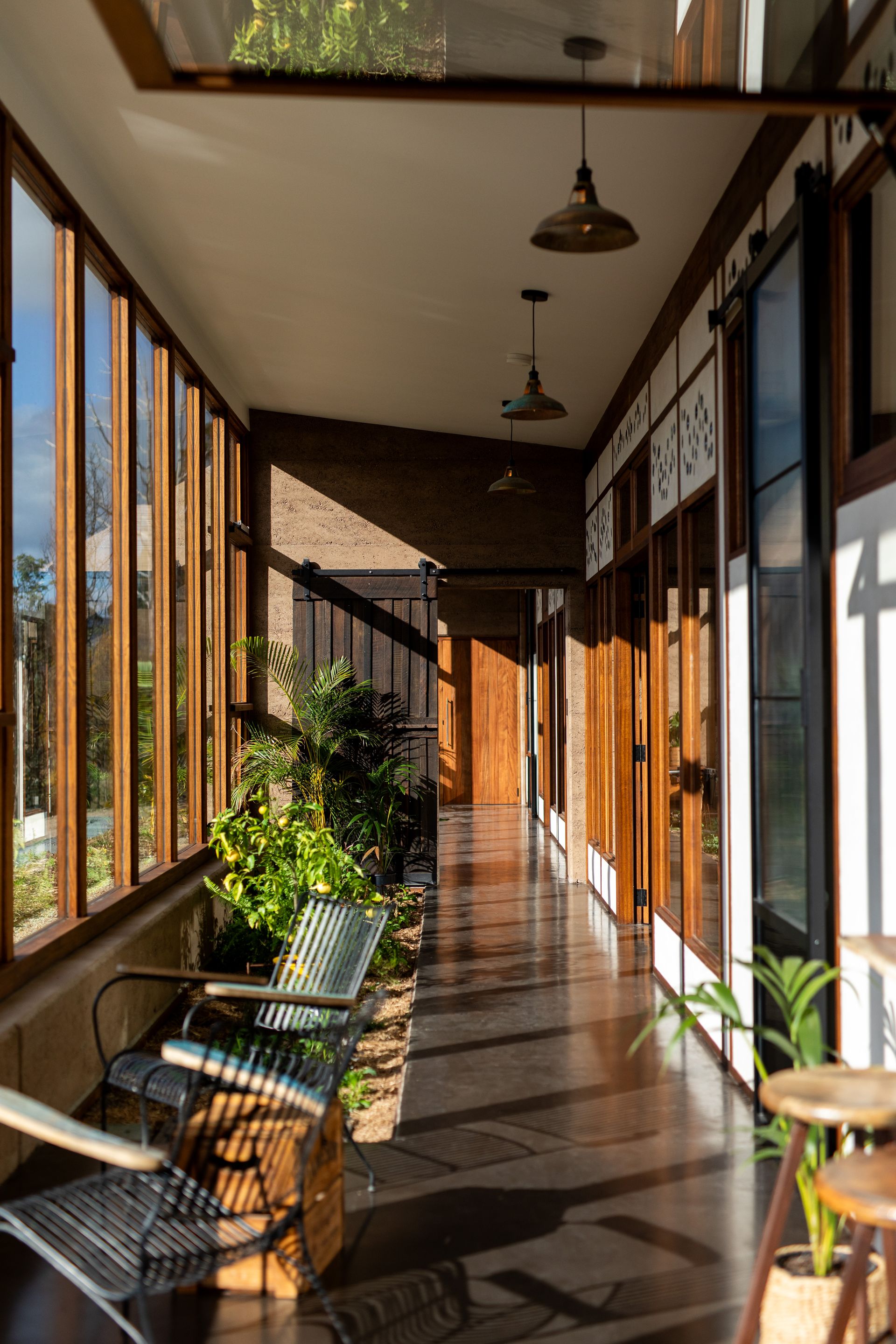
The client’s vision was to create a self-sufficient, bushfire-resilient family home as the first stage of a five-home micro eco-village near Cygnet, Tasmania. Their key objective was to demonstrate how an off-grid, low-carbon dwelling could operate entirely independent of external energy, water, or waste systems, using passive solar design, rainwater harvesting, on-site wastewater treatment, and renewable energy generation.
Affordability and replicability were essential. The project sought to prove that small-scale, owner-built cohousing can be achievable within regional communities, providing an alternative housing model that addresses rising construction costs and cost-of-living pressures.
The design promotes community building and social cohesion through the larger eco-village vision, where individual homes share infrastructure, resources, and food production. Cooperative land management and permaculture gardens enable collective stewardship and interdependence while maintaining privacy within each dwelling.
Environmental regeneration is central to the project, restoring native vegetation and waterways while achieving zero fossil fuel use and eliminating mechanical heating or cooling. The house’s modular layout supports inter-generational living and flexibility across life stages, ensuring longevity and adaptability.
Finally, the home is intended as an educational demonstration site. Through workshops, open days, and training programs, it provides a tangible model of sustainable living—showcasing how regenerative design can harmonise environmental responsibility, affordability, and community wellbeing while fitting sensitively within the existing township context.
Communication Management
The owner-builder implemented a structured communication framework with clear roles and responsibilities. Regular contact with specialist contractors was maintained through scheduled site meetings and progress reviews. All design changes were documented through a formal variation process, ensuring transparency and accountability. Coordination meetings during construction involved key trades—earthworks, concreting, foundations, carpentry, plumbing, and electrical—as well as specialists in natural building techniques such as cob, rammed earth, and hempcrete.
Budget Management
The project budget was managed through a construction loan supported by detailed cost planning and value engineering. Site-sourced materials such as cob and light earth eliminated purchase and transport costs, while locally sourced rammed earth reduced freight expenses and embodied energy. Owner-builder labour was used for non-specialist tasks, delivering significant savings. A contingency allowance was maintained, and regular cost tracking aligned construction loan drawdowns with budget milestones.
Construction Management
The owner-builder coordinated all works, engaging specialist contractors for technical trades while personally undertaking natural building components. A mid-project natural building workshop fulfilled the educational objective, engaging community participants in hands-on cob, light-earth and bottle-brick construction. Quality control measures verified correct material ratios and construction methods, particularly for rammed earth. The earth-sheltered design and earth-tube installation required close coordination with earthworks contractors.
Defect Management
Progressive inspections occurred at key stages, with contractors responsible for their own quality assurance. Natural materials required monitored curing, supported by detailed photographic documentation that created accountability records throughout construction.
The client’s vision was to create a self-sufficient, bushfire-resilient family home as the first stage of a five-home micro eco-village near Cygnet, Tasmania. Their key objective was to demonstrate how an off-grid, low-carbon dwelling could operate entirely independent of external energy, water, or waste systems, using passive solar design, rainwater harvesting, on-site wastewater treatment, and renewable energy generation.
Affordability and replicability were essential. The project sought to prove that small-scale, owner-built cohousing can be achievable within regional communities, providing an alternative housing model that addresses rising construction costs and cost-of-living pressures.
The design promotes community building and social cohesion through the larger eco-village vision, where individual homes share infrastructure, resources, and food production. Cooperative land management and permaculture gardens enable collective stewardship and interdependence while maintaining privacy within each dwelling.
Environmental regeneration is central to the project, restoring native vegetation and waterways while achieving zero fossil fuel use and eliminating mechanical heating or cooling. The house’s modular layout supports inter-generational living and flexibility across life stages, ensuring longevity and adaptability.
Finally, the home is intended as an educational demonstration site. Through workshops, open days, and training programs, it provides a tangible model of sustainable living—showcasing how regenerative design can harmonise environmental responsibility, affordability, and community wellbeing while fitting sensitively within the existing township context.
Communication Management
The owner-builder implemented a structured communication framework with clear roles and responsibilities. Regular contact with specialist contractors was maintained through scheduled site meetings and progress reviews. All design changes were documented through a formal variation process, ensuring transparency and accountability. Coordination meetings during construction involved key trades—earthworks, concreting, foundations, carpentry, plumbing, and electrical—as well as specialists in natural building techniques such as cob, rammed earth, and hempcrete.
Budget Management
The project budget was managed through a construction loan supported by detailed cost planning and value engineering. Site-sourced materials such as cob and light earth eliminated purchase and transport costs, while locally sourced rammed earth reduced freight expenses and embodied energy. Owner-builder labour was used for non-specialist tasks, delivering significant savings. A contingency allowance was maintained, and regular cost tracking aligned construction loan drawdowns with budget milestones.
Construction Management
The owner-builder coordinated all works, engaging specialist contractors for technical trades while personally undertaking natural building components. A mid-project natural building workshop fulfilled the educational objective, engaging community participants in hands-on cob, light-earth and bottle-brick construction. Quality control measures verified correct material ratios and construction methods, particularly for rammed earth. The earth-sheltered design and earth-tube installation required close coordination with earthworks contractors.
Defect Management
Progressive inspections occurred at key stages, with contractors responsible for their own quality assurance. Natural materials required monitored curing, supported by detailed photographic documentation that created accountability records throughout construction.
The client’s vision was to create a self-sufficient, bushfire-resilient family home as the first stage of a five-home micro eco-village near Cygnet, Tasmania. Their key objective was to demonstrate how an off-grid, low-carbon dwelling could operate entirely independent of external energy, water, or waste systems, using passive solar design, rainwater harvesting, on-site wastewater treatment, and renewable energy generation.
Affordability and replicability were essential. The project sought to prove that small-scale, owner-built cohousing can be achievable within regional communities, providing an alternative housing model that addresses rising construction costs and cost-of-living pressures.
The design promotes community building and social cohesion through the larger eco-village vision, where individual homes share infrastructure, resources, and food production. Cooperative land management and permaculture gardens enable collective stewardship and interdependence while maintaining privacy within each dwelling.
Environmental regeneration is central to the project, restoring native vegetation and waterways while achieving zero fossil fuel use and eliminating mechanical heating or cooling. The house’s modular layout supports inter-generational living and flexibility across life stages, ensuring longevity and adaptability.
Finally, the home is intended as an educational demonstration site. Through workshops, open days, and training programs, it provides a tangible model of sustainable living—showcasing how regenerative design can harmonise environmental responsibility, affordability, and community wellbeing while fitting sensitively within the existing township context.
Communication Management
The owner-builder implemented a structured communication framework with clear roles and responsibilities. Regular contact with specialist contractors was maintained through scheduled site meetings and progress reviews. All design changes were documented through a formal variation process, ensuring transparency and accountability. Coordination meetings during construction involved key trades—earthworks, concreting, foundations, carpentry, plumbing, and electrical—as well as specialists in natural building techniques such as cob, rammed earth, and hempcrete.
Budget Management
The project budget was managed through a construction loan supported by detailed cost planning and value engineering. Site-sourced materials such as cob and light earth eliminated purchase and transport costs, while locally sourced rammed earth reduced freight expenses and embodied energy. Owner-builder labour was used for non-specialist tasks, delivering significant savings. A contingency allowance was maintained, and regular cost tracking aligned construction loan drawdowns with budget milestones.
Construction Management
The owner-builder coordinated all works, engaging specialist contractors for technical trades while personally undertaking natural building components. A mid-project natural building workshop fulfilled the educational objective, engaging community participants in hands-on cob, light-earth and bottle-brick construction. Quality control measures verified correct material ratios and construction methods, particularly for rammed earth. The earth-sheltered design and earth-tube installation required close coordination with earthworks contractors.
Defect Management
Progressive inspections occurred at key stages, with contractors responsible for their own quality assurance. Natural materials required monitored curing, supported by detailed photographic documentation that created accountability records throughout construction.
The client’s vision was to create a self-sufficient, bushfire-resilient family home as the first stage of a five-home micro eco-village near Cygnet, Tasmania. Their key objective was to demonstrate how an off-grid, low-carbon dwelling could operate entirely independent of external energy, water, or waste systems, using passive solar design, rainwater harvesting, on-site wastewater treatment, and renewable energy generation.
Affordability and replicability were essential. The project sought to prove that small-scale, owner-built cohousing can be achievable within regional communities, providing an alternative housing model that addresses rising construction costs and cost-of-living pressures.
The design promotes community building and social cohesion through the larger eco-village vision, where individual homes share infrastructure, resources, and food production. Cooperative land management and permaculture gardens enable collective stewardship and interdependence while maintaining privacy within each dwelling.
Environmental regeneration is central to the project, restoring native vegetation and waterways while achieving zero fossil fuel use and eliminating mechanical heating or cooling. The house’s modular layout supports inter-generational living and flexibility across life stages, ensuring longevity and adaptability.
Finally, the home is intended as an educational demonstration site. Through workshops, open days, and training programs, it provides a tangible model of sustainable living—showcasing how regenerative design can harmonise environmental responsibility, affordability, and community wellbeing while fitting sensitively within the existing township context.
Communication Management
The owner-builder implemented a structured communication framework with clear roles and responsibilities. Regular contact with specialist contractors was maintained through scheduled site meetings and progress reviews. All design changes were documented through a formal variation process, ensuring transparency and accountability. Coordination meetings during construction involved key trades—earthworks, concreting, foundations, carpentry, plumbing, and electrical—as well as specialists in natural building techniques such as cob, rammed earth, and hempcrete.
Budget Management
The project budget was managed through a construction loan supported by detailed cost planning and value engineering. Site-sourced materials such as cob and light earth eliminated purchase and transport costs, while locally sourced rammed earth reduced freight expenses and embodied energy. Owner-builder labour was used for non-specialist tasks, delivering significant savings. A contingency allowance was maintained, and regular cost tracking aligned construction loan drawdowns with budget milestones.
Construction Management
The owner-builder coordinated all works, engaging specialist contractors for technical trades while personally undertaking natural building components. A mid-project natural building workshop fulfilled the educational objective, engaging community participants in hands-on cob, light-earth and bottle-brick construction. Quality control measures verified correct material ratios and construction methods, particularly for rammed earth. The earth-sheltered design and earth-tube installation required close coordination with earthworks contractors.
Defect Management
Progressive inspections occurred at key stages, with contractors responsible for their own quality assurance. Natural materials required monitored curing, supported by detailed photographic documentation that created accountability records throughout construction.
The client’s vision was to create a self-sufficient, bushfire-resilient family home as the first stage of a five-home micro eco-village near Cygnet, Tasmania. Their key objective was to demonstrate how an off-grid, low-carbon dwelling could operate entirely independent of external energy, water, or waste systems, using passive solar design, rainwater harvesting, on-site wastewater treatment, and renewable energy generation.
Affordability and replicability were essential. The project sought to prove that small-scale, owner-built cohousing can be achievable within regional communities, providing an alternative housing model that addresses rising construction costs and cost-of-living pressures.
The design promotes community building and social cohesion through the larger eco-village vision, where individual homes share infrastructure, resources, and food production. Cooperative land management and permaculture gardens enable collective stewardship and interdependence while maintaining privacy within each dwelling.
Environmental regeneration is central to the project, restoring native vegetation and waterways while achieving zero fossil fuel use and eliminating mechanical heating or cooling. The house’s modular layout supports inter-generational living and flexibility across life stages, ensuring longevity and adaptability.
Finally, the home is intended as an educational demonstration site. Through workshops, open days, and training programs, it provides a tangible model of sustainable living—showcasing how regenerative design can harmonise environmental responsibility, affordability, and community wellbeing while fitting sensitively within the existing township context.
Communication Management
The owner-builder implemented a structured communication framework with clear roles and responsibilities. Regular contact with specialist contractors was maintained through scheduled site meetings and progress reviews. All design changes were documented through a formal variation process, ensuring transparency and accountability. Coordination meetings during construction involved key trades—earthworks, concreting, foundations, carpentry, plumbing, and electrical—as well as specialists in natural building techniques such as cob, rammed earth, and hempcrete.
Budget Management
The project budget was managed through a construction loan supported by detailed cost planning and value engineering. Site-sourced materials such as cob and light earth eliminated purchase and transport costs, while locally sourced rammed earth reduced freight expenses and embodied energy. Owner-builder labour was used for non-specialist tasks, delivering significant savings. A contingency allowance was maintained, and regular cost tracking aligned construction loan drawdowns with budget milestones.
Construction Management
The owner-builder coordinated all works, engaging specialist contractors for technical trades while personally undertaking natural building components. A mid-project natural building workshop fulfilled the educational objective, engaging community participants in hands-on cob, light-earth and bottle-brick construction. Quality control measures verified correct material ratios and construction methods, particularly for rammed earth. The earth-sheltered design and earth-tube installation required close coordination with earthworks contractors.
Defect Management
Progressive inspections occurred at key stages, with contractors responsible for their own quality assurance. Natural materials required monitored curing, supported by detailed photographic documentation that created accountability records throughout construction.
The client’s vision was to create a self-sufficient, bushfire-resilient family home as the first stage of a five-home micro eco-village near Cygnet, Tasmania. Their key objective was to demonstrate how an off-grid, low-carbon dwelling could operate entirely independent of external energy, water, or waste systems, using passive solar design, rainwater harvesting, on-site wastewater treatment, and renewable energy generation.
Affordability and replicability were essential. The project sought to prove that small-scale, owner-built cohousing can be achievable within regional communities, providing an alternative housing model that addresses rising construction costs and cost-of-living pressures.
The design promotes community building and social cohesion through the larger eco-village vision, where individual homes share infrastructure, resources, and food production. Cooperative land management and permaculture gardens enable collective stewardship and interdependence while maintaining privacy within each dwelling.
Environmental regeneration is central to the project, restoring native vegetation and waterways while achieving zero fossil fuel use and eliminating mechanical heating or cooling. The house’s modular layout supports inter-generational living and flexibility across life stages, ensuring longevity and adaptability.
Finally, the home is intended as an educational demonstration site. Through workshops, open days, and training programs, it provides a tangible model of sustainable living—showcasing how regenerative design can harmonise environmental responsibility, affordability, and community wellbeing while fitting sensitively within the existing township context.
Communication Management
The owner-builder implemented a structured communication framework with clear roles and responsibilities. Regular contact with specialist contractors was maintained through scheduled site meetings and progress reviews. All design changes were documented through a formal variation process, ensuring transparency and accountability. Coordination meetings during construction involved key trades—earthworks, concreting, foundations, carpentry, plumbing, and electrical—as well as specialists in natural building techniques such as cob, rammed earth, and hempcrete.
Budget Management
The project budget was managed through a construction loan supported by detailed cost planning and value engineering. Site-sourced materials such as cob and light earth eliminated purchase and transport costs, while locally sourced rammed earth reduced freight expenses and embodied energy. Owner-builder labour was used for non-specialist tasks, delivering significant savings. A contingency allowance was maintained, and regular cost tracking aligned construction loan drawdowns with budget milestones.
Construction Management
The owner-builder coordinated all works, engaging specialist contractors for technical trades while personally undertaking natural building components. A mid-project natural building workshop fulfilled the educational objective, engaging community participants in hands-on cob, light-earth and bottle-brick construction. Quality control measures verified correct material ratios and construction methods, particularly for rammed earth. The earth-sheltered design and earth-tube installation required close coordination with earthworks contractors.
Defect Management
Progressive inspections occurred at key stages, with contractors responsible for their own quality assurance. Natural materials required monitored curing, supported by detailed photographic documentation that created accountability records throughout construction.
The client’s vision was to create a self-sufficient, bushfire-resilient family home as the first stage of a five-home micro eco-village near Cygnet, Tasmania. Their key objective was to demonstrate how an off-grid, low-carbon dwelling could operate entirely independent of external energy, water, or waste systems, using passive solar design, rainwater harvesting, on-site wastewater treatment, and renewable energy generation.
Affordability and replicability were essential. The project sought to prove that small-scale, owner-built cohousing can be achievable within regional communities, providing an alternative housing model that addresses rising construction costs and cost-of-living pressures.
The design promotes community building and social cohesion through the larger eco-village vision, where individual homes share infrastructure, resources, and food production. Cooperative land management and permaculture gardens enable collective stewardship and interdependence while maintaining privacy within each dwelling.
Environmental regeneration is central to the project, restoring native vegetation and waterways while achieving zero fossil fuel use and eliminating mechanical heating or cooling. The house’s modular layout supports inter-generational living and flexibility across life stages, ensuring longevity and adaptability.
Finally, the home is intended as an educational demonstration site. Through workshops, open days, and training programs, it provides a tangible model of sustainable living—showcasing how regenerative design can harmonise environmental responsibility, affordability, and community wellbeing while fitting sensitively within the existing township context.
Communication Management
The owner-builder implemented a structured communication framework with clear roles and responsibilities. Regular contact with specialist contractors was maintained through scheduled site meetings and progress reviews. All design changes were documented through a formal variation process, ensuring transparency and accountability. Coordination meetings during construction involved key trades—earthworks, concreting, foundations, carpentry, plumbing, and electrical—as well as specialists in natural building techniques such as cob, rammed earth, and hempcrete.
Budget Management
The project budget was managed through a construction loan supported by detailed cost planning and value engineering. Site-sourced materials such as cob and light earth eliminated purchase and transport costs, while locally sourced rammed earth reduced freight expenses and embodied energy. Owner-builder labour was used for non-specialist tasks, delivering significant savings. A contingency allowance was maintained, and regular cost tracking aligned construction loan drawdowns with budget milestones.
Construction Management
The owner-builder coordinated all works, engaging specialist contractors for technical trades while personally undertaking natural building components. A mid-project natural building workshop fulfilled the educational objective, engaging community participants in hands-on cob, light-earth and bottle-brick construction. Quality control measures verified correct material ratios and construction methods, particularly for rammed earth. The earth-sheltered design and earth-tube installation required close coordination with earthworks contractors.
Defect Management
Progressive inspections occurred at key stages, with contractors responsible for their own quality assurance. Natural materials required monitored curing, supported by detailed photographic documentation that created accountability records throughout construction.
The client’s vision was to create a self-sufficient, bushfire-resilient family home as the first stage of a five-home micro eco-village near Cygnet, Tasmania. Their key objective was to demonstrate how an off-grid, low-carbon dwelling could operate entirely independent of external energy, water, or waste systems, using passive solar design, rainwater harvesting, on-site wastewater treatment, and renewable energy generation.
Affordability and replicability were essential. The project sought to prove that small-scale, owner-built cohousing can be achievable within regional communities, providing an alternative housing model that addresses rising construction costs and cost-of-living pressures.
The design promotes community building and social cohesion through the larger eco-village vision, where individual homes share infrastructure, resources, and food production. Cooperative land management and permaculture gardens enable collective stewardship and interdependence while maintaining privacy within each dwelling.
Environmental regeneration is central to the project, restoring native vegetation and waterways while achieving zero fossil fuel use and eliminating mechanical heating or cooling. The house’s modular layout supports inter-generational living and flexibility across life stages, ensuring longevity and adaptability.
Finally, the home is intended as an educational demonstration site. Through workshops, open days, and training programs, it provides a tangible model of sustainable living—showcasing how regenerative design can harmonise environmental responsibility, affordability, and community wellbeing while fitting sensitively within the existing township context.
Communication Management
The owner-builder implemented a structured communication framework with clear roles and responsibilities. Regular contact with specialist contractors was maintained through scheduled site meetings and progress reviews. All design changes were documented through a formal variation process, ensuring transparency and accountability. Coordination meetings during construction involved key trades—earthworks, concreting, foundations, carpentry, plumbing, and electrical—as well as specialists in natural building techniques such as cob, rammed earth, and hempcrete.
Budget Management
The project budget was managed through a construction loan supported by detailed cost planning and value engineering. Site-sourced materials such as cob and light earth eliminated purchase and transport costs, while locally sourced rammed earth reduced freight expenses and embodied energy. Owner-builder labour was used for non-specialist tasks, delivering significant savings. A contingency allowance was maintained, and regular cost tracking aligned construction loan drawdowns with budget milestones.
Construction Management
The owner-builder coordinated all works, engaging specialist contractors for technical trades while personally undertaking natural building components. A mid-project natural building workshop fulfilled the educational objective, engaging community participants in hands-on cob, light-earth and bottle-brick construction. Quality control measures verified correct material ratios and construction methods, particularly for rammed earth. The earth-sheltered design and earth-tube installation required close coordination with earthworks contractors.
Defect Management
Progressive inspections occurred at key stages, with contractors responsible for their own quality assurance. Natural materials required monitored curing, supported by detailed photographic documentation that created accountability records throughout construction.
The client’s vision was to create a self-sufficient, bushfire-resilient family home as the first stage of a five-home micro eco-village near Cygnet, Tasmania. Their key objective was to demonstrate how an off-grid, low-carbon dwelling could operate entirely independent of external energy, water, or waste systems, using passive solar design, rainwater harvesting, on-site wastewater treatment, and renewable energy generation.
Affordability and replicability were essential. The project sought to prove that small-scale, owner-built cohousing can be achievable within regional communities, providing an alternative housing model that addresses rising construction costs and cost-of-living pressures.
The design promotes community building and social cohesion through the larger eco-village vision, where individual homes share infrastructure, resources, and food production. Cooperative land management and permaculture gardens enable collective stewardship and interdependence while maintaining privacy within each dwelling.
Environmental regeneration is central to the project, restoring native vegetation and waterways while achieving zero fossil fuel use and eliminating mechanical heating or cooling. The house’s modular layout supports inter-generational living and flexibility across life stages, ensuring longevity and adaptability.
Finally, the home is intended as an educational demonstration site. Through workshops, open days, and training programs, it provides a tangible model of sustainable living—showcasing how regenerative design can harmonise environmental responsibility, affordability, and community wellbeing while fitting sensitively within the existing township context.
Communication Management
The owner-builder implemented a structured communication framework with clear roles and responsibilities. Regular contact with specialist contractors was maintained through scheduled site meetings and progress reviews. All design changes were documented through a formal variation process, ensuring transparency and accountability. Coordination meetings during construction involved key trades—earthworks, concreting, foundations, carpentry, plumbing, and electrical—as well as specialists in natural building techniques such as cob, rammed earth, and hempcrete.
Budget Management
The project budget was managed through a construction loan supported by detailed cost planning and value engineering. Site-sourced materials such as cob and light earth eliminated purchase and transport costs, while locally sourced rammed earth reduced freight expenses and embodied energy. Owner-builder labour was used for non-specialist tasks, delivering significant savings. A contingency allowance was maintained, and regular cost tracking aligned construction loan drawdowns with budget milestones.
Construction Management
The owner-builder coordinated all works, engaging specialist contractors for technical trades while personally undertaking natural building components. A mid-project natural building workshop fulfilled the educational objective, engaging community participants in hands-on cob, light-earth and bottle-brick construction. Quality control measures verified correct material ratios and construction methods, particularly for rammed earth. The earth-sheltered design and earth-tube installation required close coordination with earthworks contractors.
Defect Management
Progressive inspections occurred at key stages, with contractors responsible for their own quality assurance. Natural materials required monitored curing, supported by detailed photographic documentation that created accountability records throughout construction.
The client’s vision was to create a self-sufficient, bushfire-resilient family home as the first stage of a five-home micro eco-village near Cygnet, Tasmania. Their key objective was to demonstrate how an off-grid, low-carbon dwelling could operate entirely independent of external energy, water, or waste systems, using passive solar design, rainwater harvesting, on-site wastewater treatment, and renewable energy generation.
Affordability and replicability were essential. The project sought to prove that small-scale, owner-built cohousing can be achievable within regional communities, providing an alternative housing model that addresses rising construction costs and cost-of-living pressures.
The design promotes community building and social cohesion through the larger eco-village vision, where individual homes share infrastructure, resources, and food production. Cooperative land management and permaculture gardens enable collective stewardship and interdependence while maintaining privacy within each dwelling.
Environmental regeneration is central to the project, restoring native vegetation and waterways while achieving zero fossil fuel use and eliminating mechanical heating or cooling. The house’s modular layout supports inter-generational living and flexibility across life stages, ensuring longevity and adaptability.
Finally, the home is intended as an educational demonstration site. Through workshops, open days, and training programs, it provides a tangible model of sustainable living—showcasing how regenerative design can harmonise environmental responsibility, affordability, and community wellbeing while fitting sensitively within the existing township context.
Communication Management
The owner-builder implemented a structured communication framework with clear roles and responsibilities. Regular contact with specialist contractors was maintained through scheduled site meetings and progress reviews. All design changes were documented through a formal variation process, ensuring transparency and accountability. Coordination meetings during construction involved key trades—earthworks, concreting, foundations, carpentry, plumbing, and electrical—as well as specialists in natural building techniques such as cob, rammed earth, and hempcrete.
Budget Management
The project budget was managed through a construction loan supported by detailed cost planning and value engineering. Site-sourced materials such as cob and light earth eliminated purchase and transport costs, while locally sourced rammed earth reduced freight expenses and embodied energy. Owner-builder labour was used for non-specialist tasks, delivering significant savings. A contingency allowance was maintained, and regular cost tracking aligned construction loan drawdowns with budget milestones.
Construction Management
The owner-builder coordinated all works, engaging specialist contractors for technical trades while personally undertaking natural building components. A mid-project natural building workshop fulfilled the educational objective, engaging community participants in hands-on cob, light-earth and bottle-brick construction. Quality control measures verified correct material ratios and construction methods, particularly for rammed earth. The earth-sheltered design and earth-tube installation required close coordination with earthworks contractors.
Defect Management
Progressive inspections occurred at key stages, with contractors responsible for their own quality assurance. Natural materials required monitored curing, supported by detailed photographic documentation that created accountability records throughout construction.
The client’s vision was to create a self-sufficient, bushfire-resilient family home as the first stage of a five-home micro eco-village near Cygnet, Tasmania. Their key objective was to demonstrate how an off-grid, low-carbon dwelling could operate entirely independent of external energy, water, or waste systems, using passive solar design, rainwater harvesting, on-site wastewater treatment, and renewable energy generation.
Affordability and replicability were essential. The project sought to prove that small-scale, owner-built cohousing can be achievable within regional communities, providing an alternative housing model that addresses rising construction costs and cost-of-living pressures.
The design promotes community building and social cohesion through the larger eco-village vision, where individual homes share infrastructure, resources, and food production. Cooperative land management and permaculture gardens enable collective stewardship and interdependence while maintaining privacy within each dwelling.
Environmental regeneration is central to the project, restoring native vegetation and waterways while achieving zero fossil fuel use and eliminating mechanical heating or cooling. The house’s modular layout supports inter-generational living and flexibility across life stages, ensuring longevity and adaptability.
Finally, the home is intended as an educational demonstration site. Through workshops, open days, and training programs, it provides a tangible model of sustainable living—showcasing how regenerative design can harmonise environmental responsibility, affordability, and community wellbeing while fitting sensitively within the existing township context.
Communication Management
The owner-builder implemented a structured communication framework with clear roles and responsibilities. Regular contact with specialist contractors was maintained through scheduled site meetings and progress reviews. All design changes were documented through a formal variation process, ensuring transparency and accountability. Coordination meetings during construction involved key trades—earthworks, concreting, foundations, carpentry, plumbing, and electrical—as well as specialists in natural building techniques such as cob, rammed earth, and hempcrete.
Budget Management
The project budget was managed through a construction loan supported by detailed cost planning and value engineering. Site-sourced materials such as cob and light earth eliminated purchase and transport costs, while locally sourced rammed earth reduced freight expenses and embodied energy. Owner-builder labour was used for non-specialist tasks, delivering significant savings. A contingency allowance was maintained, and regular cost tracking aligned construction loan drawdowns with budget milestones.
Construction Management
The owner-builder coordinated all works, engaging specialist contractors for technical trades while personally undertaking natural building components. A mid-project natural building workshop fulfilled the educational objective, engaging community participants in hands-on cob, light-earth and bottle-brick construction. Quality control measures verified correct material ratios and construction methods, particularly for rammed earth. The earth-sheltered design and earth-tube installation required close coordination with earthworks contractors.
Defect Management
Progressive inspections occurred at key stages, with contractors responsible for their own quality assurance. Natural materials required monitored curing, supported by detailed photographic documentation that created accountability records throughout construction.
The client’s vision was to create a self-sufficient, bushfire-resilient family home as the first stage of a five-home micro eco-village near Cygnet, Tasmania. Their key objective was to demonstrate how an off-grid, low-carbon dwelling could operate entirely independent of external energy, water, or waste systems, using passive solar design, rainwater harvesting, on-site wastewater treatment, and renewable energy generation.
Affordability and replicability were essential. The project sought to prove that small-scale, owner-built cohousing can be achievable within regional communities, providing an alternative housing model that addresses rising construction costs and cost-of-living pressures.
The design promotes community building and social cohesion through the larger eco-village vision, where individual homes share infrastructure, resources, and food production. Cooperative land management and permaculture gardens enable collective stewardship and interdependence while maintaining privacy within each dwelling.
Environmental regeneration is central to the project, restoring native vegetation and waterways while achieving zero fossil fuel use and eliminating mechanical heating or cooling. The house’s modular layout supports inter-generational living and flexibility across life stages, ensuring longevity and adaptability.
Finally, the home is intended as an educational demonstration site. Through workshops, open days, and training programs, it provides a tangible model of sustainable living—showcasing how regenerative design can harmonise environmental responsibility, affordability, and community wellbeing while fitting sensitively within the existing township context.
Communication Management
The owner-builder implemented a structured communication framework with clear roles and responsibilities. Regular contact with specialist contractors was maintained through scheduled site meetings and progress reviews. All design changes were documented through a formal variation process, ensuring transparency and accountability. Coordination meetings during construction involved key trades—earthworks, concreting, foundations, carpentry, plumbing, and electrical—as well as specialists in natural building techniques such as cob, rammed earth, and hempcrete.
Budget Management
The project budget was managed through a construction loan supported by detailed cost planning and value engineering. Site-sourced materials such as cob and light earth eliminated purchase and transport costs, while locally sourced rammed earth reduced freight expenses and embodied energy. Owner-builder labour was used for non-specialist tasks, delivering significant savings. A contingency allowance was maintained, and regular cost tracking aligned construction loan drawdowns with budget milestones.
Construction Management
The owner-builder coordinated all works, engaging specialist contractors for technical trades while personally undertaking natural building components. A mid-project natural building workshop fulfilled the educational objective, engaging community participants in hands-on cob, light-earth and bottle-brick construction. Quality control measures verified correct material ratios and construction methods, particularly for rammed earth. The earth-sheltered design and earth-tube installation required close coordination with earthworks contractors.
Defect Management
Progressive inspections occurred at key stages, with contractors responsible for their own quality assurance. Natural materials required monitored curing, supported by detailed photographic documentation that created accountability records throughout construction.
The client’s vision was to create a self-sufficient, bushfire-resilient family home as the first stage of a five-home micro eco-village near Cygnet, Tasmania. Their key objective was to demonstrate how an off-grid, low-carbon dwelling could operate entirely independent of external energy, water, or waste systems, using passive solar design, rainwater harvesting, on-site wastewater treatment, and renewable energy generation.
Affordability and replicability were essential. The project sought to prove that small-scale, owner-built cohousing can be achievable within regional communities, providing an alternative housing model that addresses rising construction costs and cost-of-living pressures.
The design promotes community building and social cohesion through the larger eco-village vision, where individual homes share infrastructure, resources, and food production. Cooperative land management and permaculture gardens enable collective stewardship and interdependence while maintaining privacy within each dwelling.
Environmental regeneration is central to the project, restoring native vegetation and waterways while achieving zero fossil fuel use and eliminating mechanical heating or cooling. The house’s modular layout supports inter-generational living and flexibility across life stages, ensuring longevity and adaptability.
Finally, the home is intended as an educational demonstration site. Through workshops, open days, and training programs, it provides a tangible model of sustainable living—showcasing how regenerative design can harmonise environmental responsibility, affordability, and community wellbeing while fitting sensitively within the existing township context.
Communication Management
The owner-builder implemented a structured communication framework with clear roles and responsibilities. Regular contact with specialist contractors was maintained through scheduled site meetings and progress reviews. All design changes were documented through a formal variation process, ensuring transparency and accountability. Coordination meetings during construction involved key trades—earthworks, concreting, foundations, carpentry, plumbing, and electrical—as well as specialists in natural building techniques such as cob, rammed earth, and hempcrete.
Budget Management
The project budget was managed through a construction loan supported by detailed cost planning and value engineering. Site-sourced materials such as cob and light earth eliminated purchase and transport costs, while locally sourced rammed earth reduced freight expenses and embodied energy. Owner-builder labour was used for non-specialist tasks, delivering significant savings. A contingency allowance was maintained, and regular cost tracking aligned construction loan drawdowns with budget milestones.
Construction Management
The owner-builder coordinated all works, engaging specialist contractors for technical trades while personally undertaking natural building components. A mid-project natural building workshop fulfilled the educational objective, engaging community participants in hands-on cob, light-earth and bottle-brick construction. Quality control measures verified correct material ratios and construction methods, particularly for rammed earth. The earth-sheltered design and earth-tube installation required close coordination with earthworks contractors.
Defect Management
Progressive inspections occurred at key stages, with contractors responsible for their own quality assurance. Natural materials required monitored curing, supported by detailed photographic documentation that created accountability records throughout construction.
The client’s vision was to create a self-sufficient, bushfire-resilient family home as the first stage of a five-home micro eco-village near Cygnet, Tasmania. Their key objective was to demonstrate how an off-grid, low-carbon dwelling could operate entirely independent of external energy, water, or waste systems, using passive solar design, rainwater harvesting, on-site wastewater treatment, and renewable energy generation.
Affordability and replicability were essential. The project sought to prove that small-scale, owner-built cohousing can be achievable within regional communities, providing an alternative housing model that addresses rising construction costs and cost-of-living pressures.
The design promotes community building and social cohesion through the larger eco-village vision, where individual homes share infrastructure, resources, and food production. Cooperative land management and permaculture gardens enable collective stewardship and interdependence while maintaining privacy within each dwelling.
Environmental regeneration is central to the project, restoring native vegetation and waterways while achieving zero fossil fuel use and eliminating mechanical heating or cooling. The house’s modular layout supports inter-generational living and flexibility across life stages, ensuring longevity and adaptability.
Finally, the home is intended as an educational demonstration site. Through workshops, open days, and training programs, it provides a tangible model of sustainable living—showcasing how regenerative design can harmonise environmental responsibility, affordability, and community wellbeing while fitting sensitively within the existing township context.
Communication Management
The owner-builder implemented a structured communication framework with clear roles and responsibilities. Regular contact with specialist contractors was maintained through scheduled site meetings and progress reviews. All design changes were documented through a formal variation process, ensuring transparency and accountability. Coordination meetings during construction involved key trades—earthworks, concreting, foundations, carpentry, plumbing, and electrical—as well as specialists in natural building techniques such as cob, rammed earth, and hempcrete.
Budget Management
The project budget was managed through a construction loan supported by detailed cost planning and value engineering. Site-sourced materials such as cob and light earth eliminated purchase and transport costs, while locally sourced rammed earth reduced freight expenses and embodied energy. Owner-builder labour was used for non-specialist tasks, delivering significant savings. A contingency allowance was maintained, and regular cost tracking aligned construction loan drawdowns with budget milestones.
Construction Management
The owner-builder coordinated all works, engaging specialist contractors for technical trades while personally undertaking natural building components. A mid-project natural building workshop fulfilled the educational objective, engaging community participants in hands-on cob, light-earth and bottle-brick construction. Quality control measures verified correct material ratios and construction methods, particularly for rammed earth. The earth-sheltered design and earth-tube installation required close coordination with earthworks contractors.
Defect Management
Progressive inspections occurred at key stages, with contractors responsible for their own quality assurance. Natural materials required monitored curing, supported by detailed photographic documentation that created accountability records throughout construction.